


|
Discover how to weave Miyuki beads on a loom.
|
|---|
| For this project you need: | ||||
|
|
||||
| Weaving techniques: | ||||
|
Find this technique soon in another tutorial. |
||||
| Step 1: | ||||
|
|
To start, choose the thread color. Choose your pattern and create a grid/diagram that will guide you for the assembly. Make a knot on one of the pivots.
|
|||
|
While holding the spool in your hand, place the thread between the spring up to the opposite spring. Wrap the thread around the pivot several times and return to the first pivot.
|
 |
|
|
Continue like this until you reach the desired number of rows. To know the desired width and thus the number of thread rows:
Then make a knot by returning to the first pivot. For an odd number of beads, finish on the first.
|
| Step 2: | ||||
|
Cut a new thread of about 1.5m (depending on the project)
Make a double knot on the outer thread to the right.
|
 |
|||
| Step 3: | ||||
 |
Then, place the needle on the thread. Depending on the clasp used, you can weave the thread by alternating passing under and over the threads. Do 3 or 4 back and forth. Use this technique with tube clasps but not for a neat finish (e.g., cuff). Then string the beads of the first row following the grid. |
|||
|
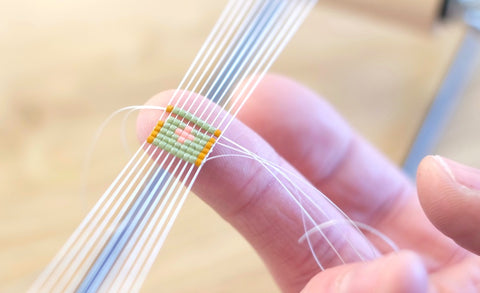
Pass the beads under the loom then, with a finger, position the beads between the threads and pass the needle back through the row of beads. The thread first passes under the vertical threads then over. The beads therefore slide on the threads.
|
 |
|
|
Continue like this until you reach the desired number of rows. If you need to join a thread, make sure the knot is hidden inside a bead. |
|
|
| Step 4: | ||||
|
Once the weaving is finished, cut the threads at the pivots. Be very careful because the beads slide on the threads.
|
 |
|||
|
|
For a flexible bracelet, you will have woven the threads at the beginning and at the end. Then you will tie knots with the threads. The first with the second, the second with the third... to lock the beads. You can use a tube clasp to insert the first row of beads plus the threads or a magnetic clasp...
|
|
For a neat finish or to glue the weaving onto a structure, for example, And there you go! |
 |
No product was found in this collection
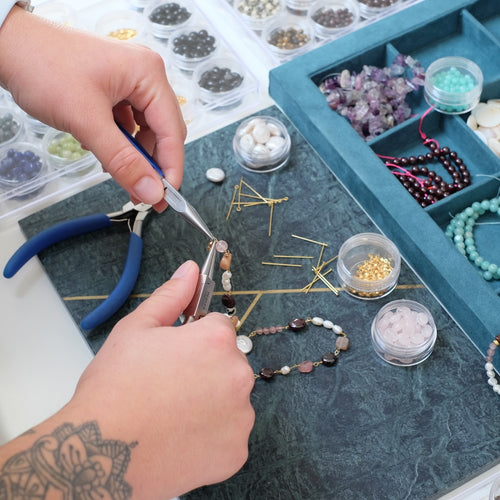
To be reserved alone or with friends!

Inspirations, tutorials, and new arrivals: receive the best of handmade in your inbox.


 A loom
 Miyuki Délica 11/0 beads or Rocailles 11/0 beads