


Updated on 16 October 2026
To buy quality beads online, choose a website that can tell you exactly what you are buying: the precise name of the stone, the plating, the origin, the hole size. Giant catalogues win you over with choice, but it is the accuracy of the information that sets a reliable supplier apart from an anonymous batch. Here are the 7 criteria we apply ourselves, after more than ten years of selecting beads and findings in our Parisian shop and workshop.
The essentials in 30 seconds
Stones: an exact name, any treatment disclosed, and someone trained in gemmology behind the selection.
Plating: 24K fine gold plated or 3-micron gold plating, rather than a thin flash plating that tarnishes quickly.
Metal: nickel- and lead-free, compliant with REACH regulations.
Product pages: size, hole, quantity and real photos, otherwise move on.
Brands: genuine Japanese Miyuki beads, genuine Czech Bohemian beads.
Advice: tutorials, a reachable customer service team, clear returns.
The 7 criteria for choosing a bead website

- Honestly identified stones. A natural stone has an exact name: “amazonite”, not “blue stone”. If it is dyed or treated, the product page must say so. The safest option is a seller with real expertise in gemmology: at our shop, every stone is checked by Sébastien Bocchese, certified in gemmology.
- A stated origin. Where do the stones come from, where are the findings made? A trustworthy website will answer. A vague answer often hides batches bought by weight, with no traceability.
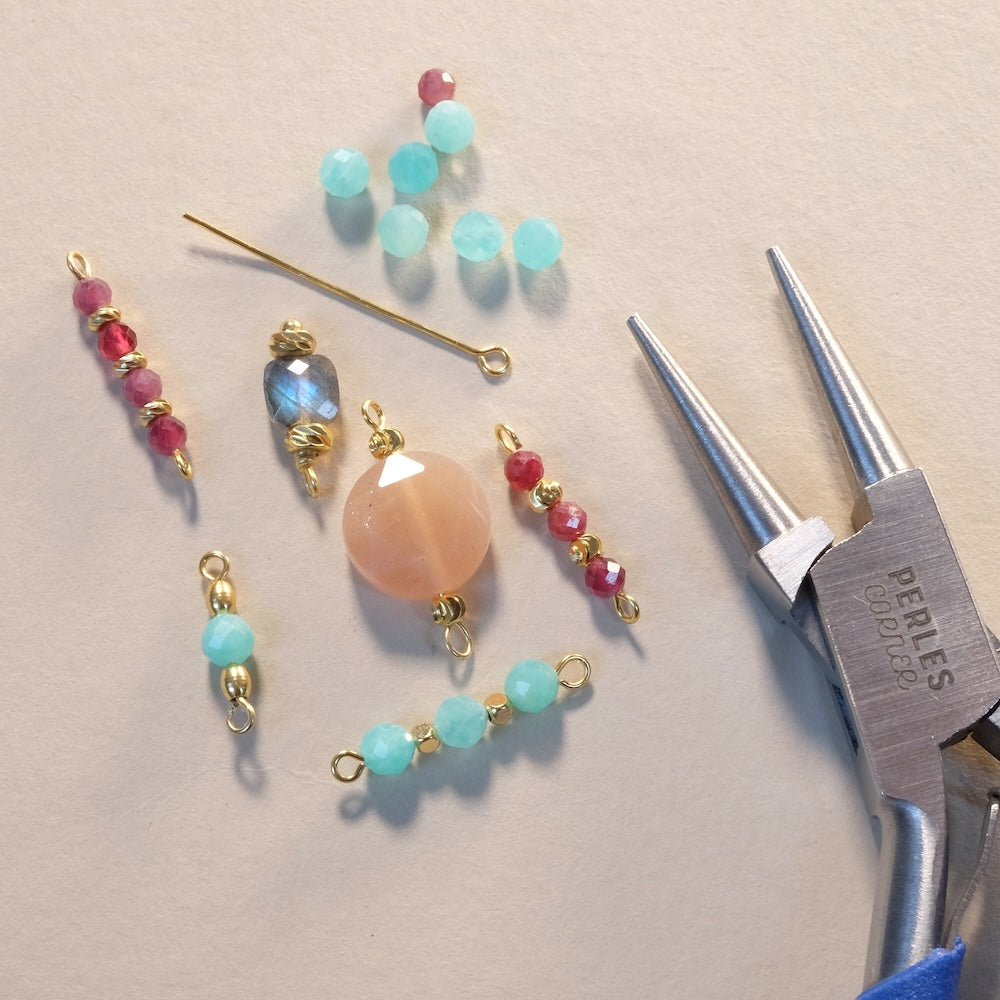
- Plating that lasts. It is the difference you cannot see when you buy and cannot miss after a few weeks of wear. Look for “24K fine gold plated” or “3-micron gold plating”, with the thickness or process stated.
- Nickel- and lead-free. For jewellery worn against the skin, findings must comply with the European REACH regulations. This should be stated on the product page or on a dedicated page.
- Complete product pages. Size, hole diameter, quantity per pack, strand length, real photos of the product. Without the hole diameter, there is no way to know whether your thread will fit through.
- Authentic brands. For bead weaving, Japanese Miyuki beads are the benchmark for their consistent sizing. For glass, Bohemian beads come from the Czech Republic. A good website gives the original reference (for example DB0203 for a Delica).
- Advice and real service. Tutorials, shopping lists, answers to your questions, clear return conditions, and ideally a shop where you can see the materials.
Warning signs
- “Natural stone” with no stone name, or fanciful names (“cherry quartz”, “sea opal”) that often refer to glass.
- “Gold-plated” or “gold-coloured” with no details of the process.
- No mention of nickel or REACH for the findings.
- Identical photos from one colour to the next, or catalogue images instead of the actual piece.
- No hole diameter, no exact quantity per pack.
- Very low prices for stones presented as rare: a quality amethyst or lapis lazuli has a cost.
Huge catalogue or specialist shop?

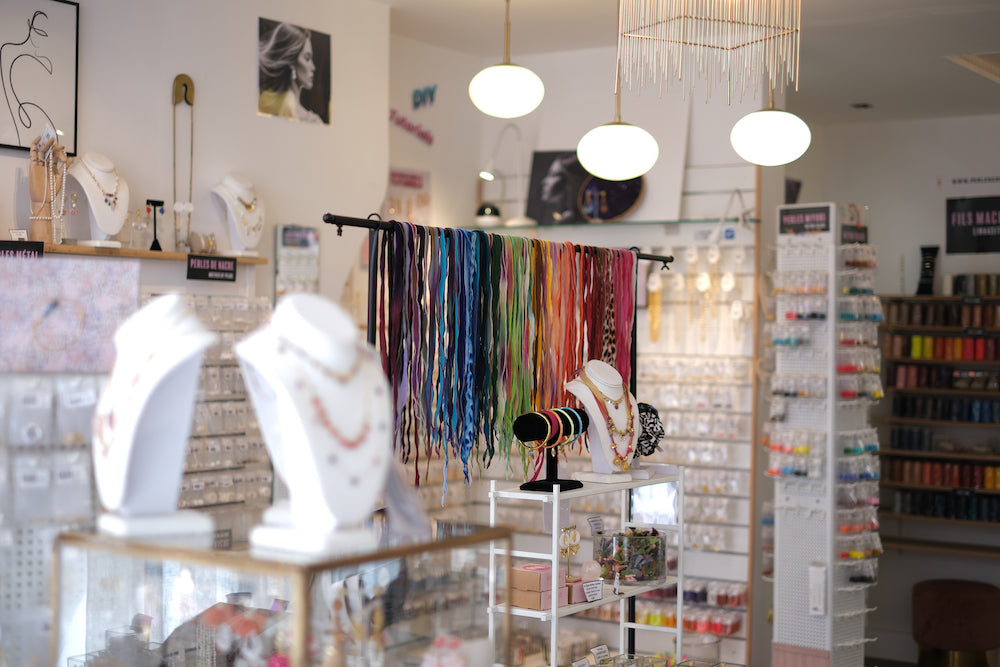
Both have their merits. A very large catalogue is handy for finding a specific reference or buying in bulk. A specialist shop stocks fewer references, but knows each one individually: where the stones come from, who makes the findings, which threads, beads and clasps work together.
For a piece of jewellery you will wear for a long time, or give as a gift, the second option avoids unpleasant surprises: plating that turns black, a stone that bleeds colour, a hole too small for your thread.


What Perles Corner actually does

Since 2012, our shop and workshop at 11 rue Oberkampf (Paris 11th) and our website have applied these criteria:
- Natural stones checked by Sébastien Bocchese, certified in gemmology. A large share is selected and crafted in our partner workshops in Jaipur, India (cabochons, beads, settings, rosary chains...); the rest comes from other suppliers.
- Made in Europe findings and chains: 24K fine gold plated, 3-micron gold plating, 925 silver-plated and 925 silver, nickel- and lead-free, REACH compliant. We have worked with European manufacturers for more than 10 years. A relationship built on trust.
- Japanese Miyuki beads with their original references, and Bohemian beads in Czech glass.
- Detailed product pages: size, hole, quantity, for nearly 6,000 items online.
- Advice: free tutorials, small-group workshops, and two books by Kevin Bruneel for Perles Corner, Atelier Bijoux (Éditions Marie Claire) and Tissage de perles (Créapassions).
- Delivery across France and Europe, free from €59 to a pickup point, and free in-store collection.
Frequently asked questions
How can you tell whether a stone is really natural?
Check that the product page gives the exact name of the stone and discloses any treatment (dyeing, stabilisation). Buy from a seller trained in gemmology who can answer your questions.
What does “24K fine gold plated” mean?
The metal finding receives a layer of pure 24-carat gold. It keeps its shine far longer than a simple gold-coloured plating.
Are Miyuki beads worth the price?
For bead weaving, yes: their consistent sizing gives a neat piece, row after row. For a simple bracelet, other glass beads work perfectly well.
Can you buy beads in small quantities?
Yes. At Perles Corner, most beads and findings are sold in small packs, so you can experiment without breaking the bank.

Kevin Bruneel, co-founder of Perles Corner.
A former professional dancer and stylist, he founded Perles Corner in 2012 with Sébastien Bocchese, certified in gemmology. He is the author of two books on jewellery making, Atelier Bijoux (Éditions Marie Claire) and Tissage de perles (Créapassions).